Pages

Monday, 20 April 2015

Breakthrough in the '70s

For this game we left the usual setting of the mid-1980s and went back to the early 1970s. The scenario saw a hastily assembled US force of a mechanised platoon, an anti-tank section and an armored cavalry section on a mission to stop a breakthrough by a Soviet company of T62s with a motor rifle platoon in BMPs attached. 

The table is below , from the Soviet entry edge. We were trying out a new Cigar Box Grasslands Mat with stuff under it to make areas of high ground in the bottom right, top right and top left of the picture, but they don't don't show up so well in the pictures which is lesson for next time. The trees show the extent of a dense wood and there are two field of crops.


The US deployed blinds. The bottom left and the 2 on the right are concealed from the Soviet side by high ground.

The Soviets sent a blind along the road to flush out any US in the village but failed to spot anything.

Two more blinds advanced uphill check out the wood.

The blind in the wood was found to be a dummy, as was the Soviet blind on the road. Another Soviet blind advanced through the centre to try another spot on the village.

Soviet spotting was poor but the central blind was revealed to be a platoon of T62s.

The 2 blinds moving uphill by the wood was also spotted and shown to be the infantry platoon dismounted with the BMPs behind in support.

Failure to spot the US blind in the cornfield led to an outbreak of impetuosity by the Soviet infantry who rushed forward on higher than expected movement dice followed by the BMPs on a Breakthrough card.

The US infantry platoon deployed off its blind and opened fire.

The first Soviet squad suffered badly and 2 of the BMPs were destroyed by M67s and M72s.

Another Soviet tank platoon moved through the cornfield on the Soviet left and was spotted by a US blind that deployed as the anti-tank section. It moved into a firing position of high ground and.....
.....made quick work of the T62s.

The US infantry's M113s had been deployed separately behind the ridge and cam of their blind to fire on the Soviet infantry, inflicting casualties including the last BMP.

The 3rd Soviet tank platoon advance over the hill past the wood and fired into the US infantry.

The M113s were spotted by a T62 who accounted for 2 with well-aimed shots from the halt.

With the threat to the US right dealt with, the anti-tank platoon moved to flank the Soviet tanks using the buildings to hide their movements.

The Soviet tanks poured HE into the US infantry's fox holes putting one section out of the battle as Soviet infantry also suffered.

The Sheridans of the armored cavalry section revealed their position to fire at the Soviet tanks. The range was too short for Shillelaghs so they had to fire shells which immediately broke their sights. Two T62s were hit and brewed up. However the Sheridans received return fire and some uncannily accurate shooting hit all 3.

An M113 mounting a recoilless rifle was destroyed by an overwatching T62.....

......that was then knocked out by the other anti-tank vehicle.

M67s accounted for 2 more T62s leaving the Soviets down to less than a platoon and the breakthrough was prevented.

A note on models - the US are all Battlefront, the T62s are by QRF, the BMPs are by Skytrex and the Soviet infantry are from Irregular.

Thursday, 16 April 2015

Im Garten - Getting Ready for OML3

I've been busy getting the town to look more like a town. I've been taken with the 4ground buildings ever since I saw them, especially because it's possible to put figures inside on each floor. To get the best out of them they need some surroundings.

First I made some pavement using mdf and some adhesive covering with a paved effect:

  Then I set to work on the gardens. Mdf with grass matting and fences from ebay, more of the self-adhesive paving for a patio, and some clutter from a German model railway  manufacturer:

The flowers were from ebay:

 I've also made versions without the fences in case someone tries to drive a T80 through the gardens - tut, no respect for property those commies!
 Overall that looks more like a nice neat German town.

Warning to chopper pilots - watch out for the cables! Despite being HO OO scale these work very well and should make life difficult for Hind pilots.

Friday, 27 March 2015

Gearing Up for OML3

6 June is D-Day, or maybe that should be L-Day as it will be the third Lardy Games Day in the glorious Vale of Evesham hosted by the Wyvern Wargames guys. Having got my booking in early I shall be there, and will be putting on another episode of IABNM.

The previous 2 OMLs have been a lot of fun but there's been one problem. To put it bluntly, my tables haven't been up to it. If you saw any of the photos from OML2 you will have been struck by the high quality of the terrain - Sidney Roundwood's Verdun showed what could be done with a bit of effort: 

http://infrequentwargamer.blogspot.co.uk/2014/06/operation-market-larden-2-part-2-verdun.html
 
So I need to make a better job of it this year.

To this end I've started to get organised. The scenario isn't set in stone yet - in fact there might be one, two, or one big game(s) depending on interest - but I've got a pretty good idea of what I want to do.

First, I've acquired a river from ebay and a bridge from Ironclad:

The bridge is actually 20mm I think but it makes a pretty good big robust West German structure:


A trawl through ebay has also come up with some stuff intended for model railways but very suitable for the fighting around the Fulda Gap. The correct gauge for 15mm is TT but I've found that some HO (1/87) will fit in:


I might want to represent the Bundesbahn too and have enlisted the help of the 'Evil Empire' who make some decent stuff:


Also been working my way through my lead (and plastic and resin) pile, completing the company of T62s (QRF):

and a US mech company (Battlefront with QRF Ford MUTTs), the infantry already being done:

There will be regular updates as the table (all 8' by 6' of it) starts to take shape.


Monday, 26 January 2015

Counter-Attack

IABNM has been taking longer than expected to complete, largely because other things like life have got in the way. There were a few issues with which I haven't been completely happy, and last week  I got the inspiration - and time - to sit down and work out some solutions. This set up the following test game.

This is an attack-defence scenario based on a West German counter-attack after Soviet forces had been halted by NATO resistance. The Germans had a Panzergrenadier company in Marders supported by a platoon of Leopard 2s and the battalion 120mm mortars. They were faced by a motor rifle company minus its BTRs, but with a pair of 100mm anti-tank guns (yes they still had towed anti-tank guns in front line units) in support and the battalion Zampolit (commissar) on hand to remind the troops of the historic inevitability of their victory.

The table is shown below from the west. The Bundeswehr had the mission of seizing the crossroads. There were 2 woods, a country hotel and a pair of cornfields with the crops high and ready to harvest.


The Soviets deployed their blinds making use of terrain and to block likely avenues of advance.

Viewed from the Soviet side, the Germans sent one blind along the road but kept the rest to the flanks. A thrust to the south looked likely.

The leading blind in the south seeking to drive through the cornfield was revealed to be the tank platoon.

The Leopard 2s advanced in echelon to leave large trails through a farmer's crops as 2 more blinds following behind went unspotted.

Excellent German optics revealed a Soviet infantry platoon lying in wait on the other side of the field.

Who started to take losses from the tanks' Rheinmetall 120mm guns.

Another blind was revealed to be concealing a platoon in Marders who added to the fire on the Soviet infantry with 20mm auto-cannons.

Defending the perimeter of the pension was another Soviet infantry platoon who opened fire with RPGs on the Marders.

Meanwhile to the north, another German panzergrenadier platoon had worked its way on foot to the eastern edge of the wood where it came under fire from Soviet infantry deployed in the wood opposite.

The panzergrenadiers exited the Marders and added their fire against the facing Soviet infantry.

On the extreme north of the table, between the two woods, the Soviet support platoon joined in the battle with the machine gun section firing on the German infantry as the anti-tank section waited for a target.

The panzergrenadiers had left their carriers just in time as RGPs found their targets and put a pair of Marders out of the battle and inflicting shock on the infantry they had been supporting.

In the centre the other panzergrenadier platoon came off its blinds and poured fire into the wood in front.

The combined firing of tanks, IFVs and infantry was too much for the Soviet motor riflemen a the edge of the field and they ran leaving their dead behind. The Leopards received an 'Assault' order and switched their attention to the Soviet troops in front of the hotel. The Soviets fought back with RPGs and small arms under the leadership of the platoon commander and the Zampolit.

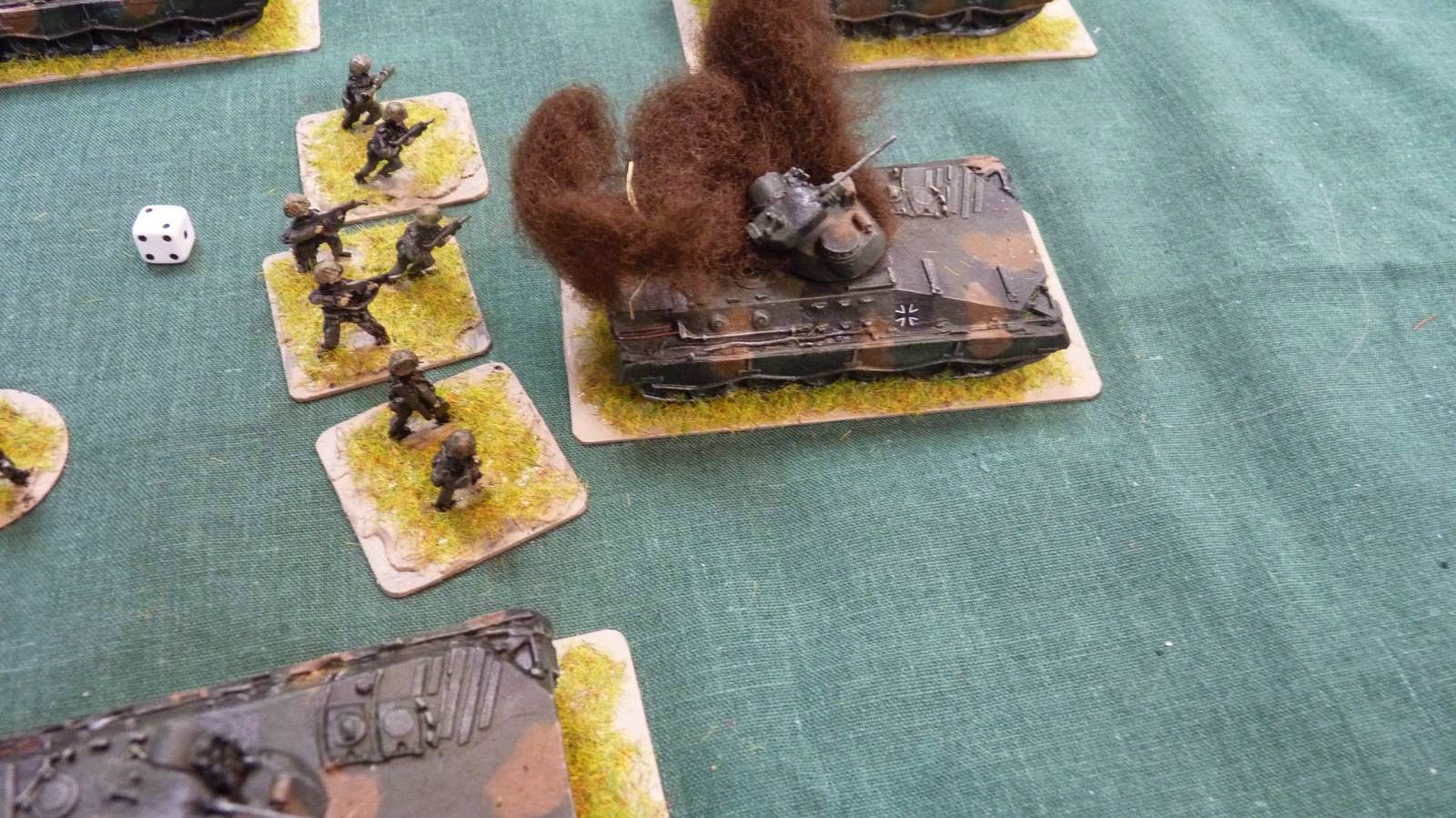
A Spigot operator saw one of the Leopards move around the corned of the field and launched a missile at it. The tank commander reacted by firing his smoke dischargers to instantly screen the vehicle and the missile flew harmlessly past.

Marders moved around the wood to support their infantry in the firefight, producing a dangerous bottleneck. The weight of fire was too much for the Soviet infantry who melted away into the wood.

Close range firing by the tanks sent one Soviet section reeling back.

The Soviets were left with one last card to play if they were to stop the Germans. The Blinds Card was dealt and the 100mm anti-tank guns appeared on the table.

Two well-aimed shots by one gun at the Leopards both missed although the other gun knocked out a Marder. The guns immediately came under fire from the infantry and Marders in the centre inflicting casualties on the crew.

The Leopards pressed forward and swiftly accounted for the anti-tank guns before they could fire again.

Result - a decisive West German victory. The Germans were able to focus their firepower on while the Soviet anti-tank assets were unable to affect the result, firing only briefly and with a lack of accuracy.
The new firing table with amended rules on pinning  and suppression were effective and the new tank platoon orders worked. Overall a good test of the rules.

Tuesday, 4 November 2014

Red on Red

I was somewhat startled to see how long it had been since I updated the blog. It's not that I haven't been wargaming - including plenty of C20 like Chain of Command, IABSM, IABNM, Squarebashing and even a modern tournament - it's just that I've been a rather slovenly blogger. Perhaps too busy palying to write is a better way of phrasing it.

Development of IABNM continues, including this recent Commie versus Commie clash in 6mm. The game was set in the late 1980s based on the Sino-Soviet split getting nasty again. The Soviets were seizing the initiative and launching an assault with a reinforced motor rifle company against positions held by a PLA infantry company.

The table as seen from the Chinese side is below:


The Chinese force consisted of 3 infantry platoons, one with an HJ-8 ATGM attached, and a platoon of Type 63 light tanks. One platoon deployed on a blind on the edge of a field on the Chinese left, another deployed in the village with the company commander and the third deployed on a blind between two woods with the ATGM positioned to fire across the table. The Type 63s took up turret down positions behind the low ridge. A dummy blind was placed to 'watch' the right flank.

The Soviet force was a full motor rifle company in BMP2s; 3 rifle platoons, a machine gun section and a grenade launcher section. This was supported by a platoon of 3 T72s which was split up to provide each motor rifle platoon with one tank in 'intimate support'. The Soviet commander could also call upon 4 Mi-24s armed with rocket pods as flying artillery support. The mission was to inflict maximum damage on the Chinese forces in the area and ensure that they could not interfere with a Soviet advance to the Chinese table edge. The Chinese were tasked with stopping this.

The Soviets entered the table on blinds but were quickly spotted and the toys came out of the box. 2nd platoon covered the woods, coming off blinds dismounted with their BMPs held back to give covering fire should the infantry meet opposition from the edge of the woods.  3rd platoon advanced very quickly over the ridge but failed to spot the Chinese infantry in the fields.

1st platoon advanced across fields straight towards the village with the MG and AGL sections in support behind.

The Soviet 3rd platoon had advanced too quickly. The Chinese Type 63s came off their blind and opened fire.

Two BMPs were and the tank were hit. The 85mm rounds made no impact on the T72 but the thinly armoured BMPs were easily penetrated and their passengers piled out suffering shock and casualties to be engaged by the Chinese infantry.

The T72 immediately retaliated and destroyed 2 of the T63s. The surviving light tank drove quickly away to seek shelter at the far end of the ridge.


 In the centre a Chinese ATGM operator put the crosshairs of his sight onto a T72 and launched a missile. The Soviet tank had prudently reserved an action from its turn just in case of such an occurrence and fired its smoke dischargers to block the missile operator's view of the target. It was to no avail as the missile struck the tank's side and, true to form, the T72 exploded.


 The remaining Type 63 saw an opportunity. It moved into the open, aimed and fired at a BMP, scoring a hit that destroyed the IFV and accounted for several of the passengers. The Soviet infantry piled out of the remaining BMPs and came under fire from the Chinese infantry platoon with the ATGM.

The commander of the Soviet 1st platoon remained in his BMP to direct its fire. It had the chance of shot on the Type 63 - decision time, a couple of bursts with its 30mm or a Spandrel ATGM? The missile was selected which turned out to be a sound choice as it tore the light tank apart.
 With 2 out of 3 platoons heavily engaged and one tank destroyed, the Soviet commander called for the air support. He didn't have long to wait as 2 pairs of Hinds flew on at low level to attack the defenders.
 Mass discharges of 57mm high explosive rockets inflicted serious losses and shock on the Chinese infantry, but they held their positions.

A pair of firefights ensued as the Chinese infantry in the village joined in the action firing on the Soviet infantry in the centre. The hitherto unengaged Soviet 2nd platoon advanced through the wood and launched a close assault on the Chinese. This was too much for the Chinese who were overrun.

The tide had turned. The Soviets concentrated fire from 2 platoons and the support sections on the village. The auto-grenade launchers proved particularly effective against the Chinese positions. On the Chinese left, the Soviet tank proved the game winner. Surviving 2 Type 69 RPG hits, it fired high explosive rounds with spectacular success against the defenders still reeling form the shock of the Hind strike. With the PLA running out of bottle, the defence collapsed.